

Where Sensors Fit in AGVs and AMRs
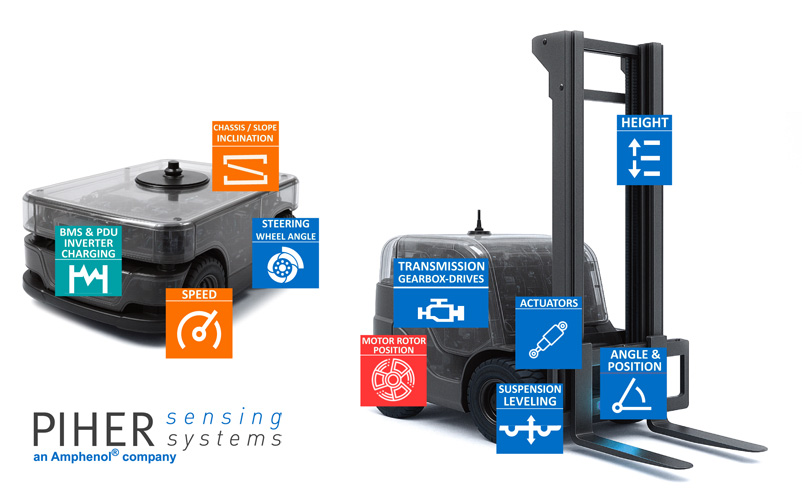
An AGV or AMR needs to know where its wheels are pointing, how fast they are moving, what the motor is doing and whether the vehicle or a mechanism is tilting.
Those jobs call for different sensors. Here are some examples of where PIHER sensing technologies can fit.
Steering and rotary position
Steering systems need accurate position feedback without adding much size to the assembly.
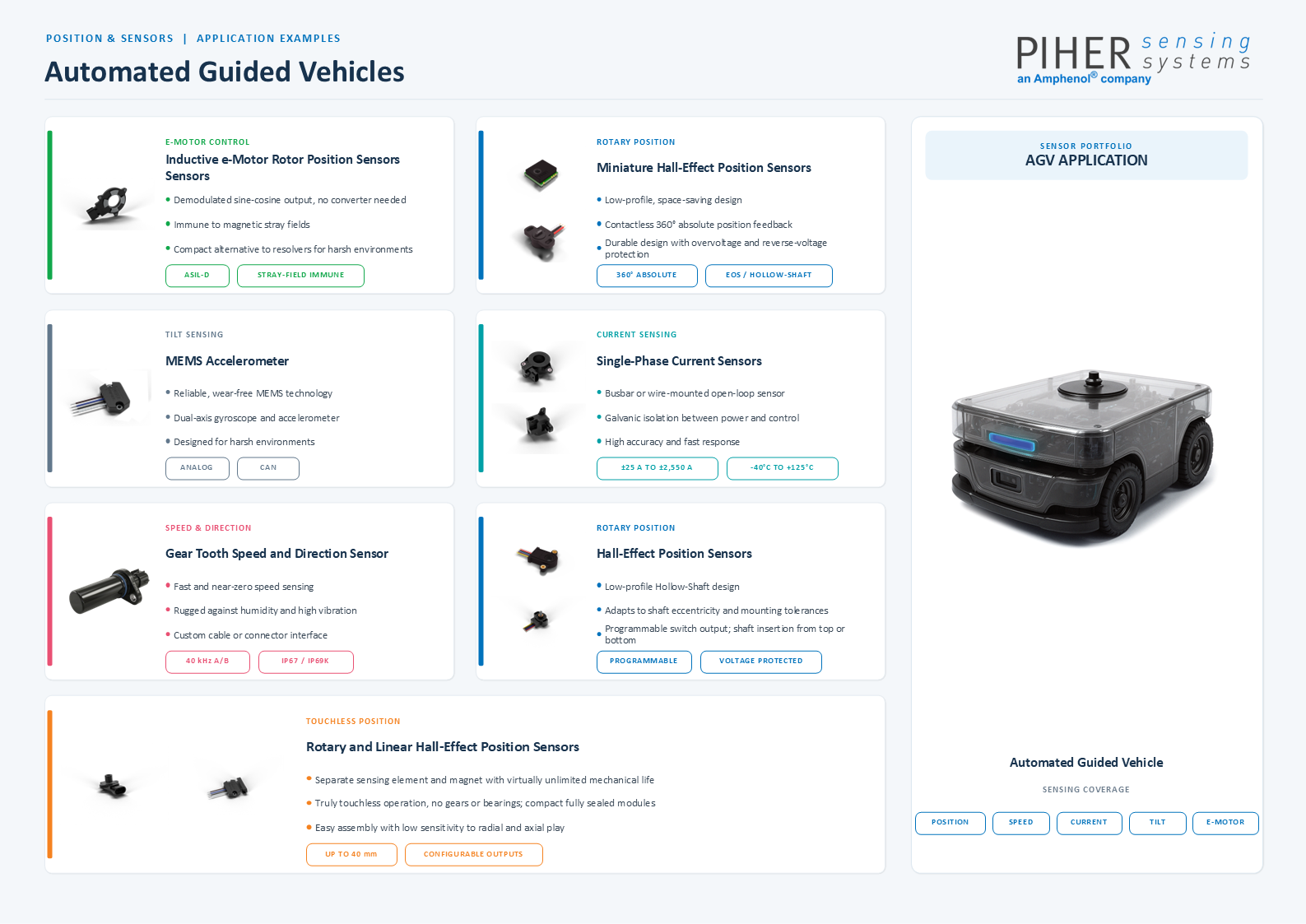
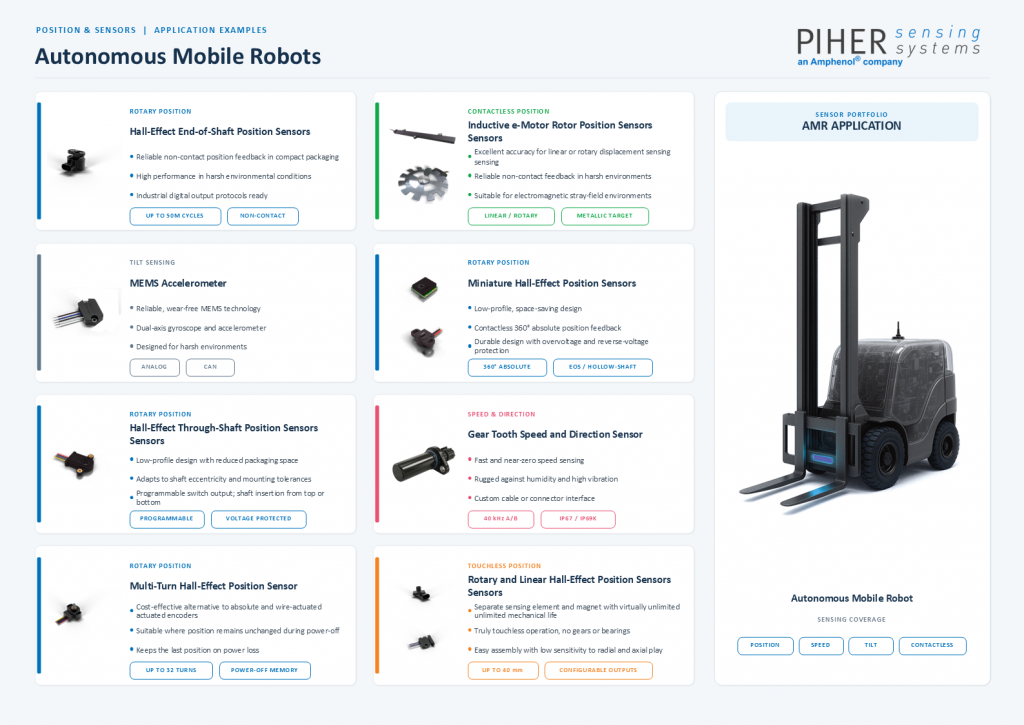
PIHER Hall-effect rotary position sensors can measure position without mechanical contact. Miniature versions are available for end-of-shaft and hollow-shaft mounting and provide 360 degree absolute position feedback.
Through-shaft versions can also accommodate shaft eccentricity and mounting tolerances. Their design allows the shaft to enter from the top or bottom, which can simplify mechanical integration.
A typical use would be measuring steering angle on a driven or steerable wheel.
Linear and rotary mechanisms
Not every movement needs the sensor to touch the moving part.
PIHER touchless Hall-effect sensors use a separate sensing element and magnet. With no gears or bearings between them, there is no mechanical contact in the measurement.
That can suit rotary mechanisms as well as linear movement. Linear versions can be configured for strokes up to 40 mm.
Examples include:
- lift position
- actuator travel
- linkage position
- rotary mechanism feedback
Options include magnet mounting, output protocols and connector assemblies.
Multi-turn position
Some mechanisms move through several full rotations rather than one.
For these applications, PIHER multi-turn Hall-effect sensors can provide up to 32 turns of absolute position feedback. They also retain the last position when power is removed.
That can be useful where a mechanism stays in place during power-off and the controller needs to know its position again after restart.
Motor rotor position
Electric drive systems also need rotor position feedback.
PIHER inductive e-motor rotor position sensors can measure rotary or linear displacement without contact. The sensing target can be integrated into the application, and the technology is suitable for environments with electromagnetic stray fields.
For some AGV motor-control applications, the sensors can provide demodulated sine-cosine output without an additional converter. Sensor-level functional safety up to ASIL-D is also available in applicable designs.
Wheel speed and direction
Low-speed movement matters in mobile robotics. The controller may need useful feedback even when the vehicle is creeping into position.
PIHER gear-tooth speed and direction sensors support near-zero-speed sensing and provide a 40 kHz A/B output.
The application sheet also specifies IP67 and IP69K sealing, along with resistance to humidity and high vibration.
A typical use would be monitoring the rotation and direction of a drive wheel or geared mechanism.
Tilt measurement
Tilt sensing can help monitor the vehicle itself or a moving structure mounted on it.
PIHER MEMS tilt sensors combine a dual-axis gyroscope and accelerometer. They are available with analog and CAN outputs.
Possible uses include monitoring:
- vehicle inclination
- mast angle
- lift mechanisms
- platforms that must remain within a defined tilt range
Because the sensing technology is wear-free, there are no contacting parts to wear during operation.
Current sensing
Power electronics need measurement too.
For AGV DC/DC converter applications, PIHER single-phase current sensors can measure current from ±25 A to ±2,550 A.
They can be mounted around a busbar or wire and provide galvanic separation between the power and control sides. Analog ratiometric output options are available, with an operating range from -40°C to +125°C.
Match the sensor to the movement
The useful question is not simply “Which sensor should an AGV use?”
It is more specific:
- Do you need to measure one revolution or several?
- Is the movement rotary or linear?
- Can the sensor touch the moving part?
- How much space is available?
- Does the mechanism have shaft or mounting tolerances?
- Do you need speed, direction, tilt or electrical current rather than position?
Answering those questions narrows the choice quickly.
PIHER offers Hall-effect, inductive, MEMS and current sensing technologies for these different measurement points, with options for mechanical configuration, outputs, magnets, cables and connectors.