

Dual-Output Hall-Effect Rotary Position Sensors for Harsh Environment Feedback
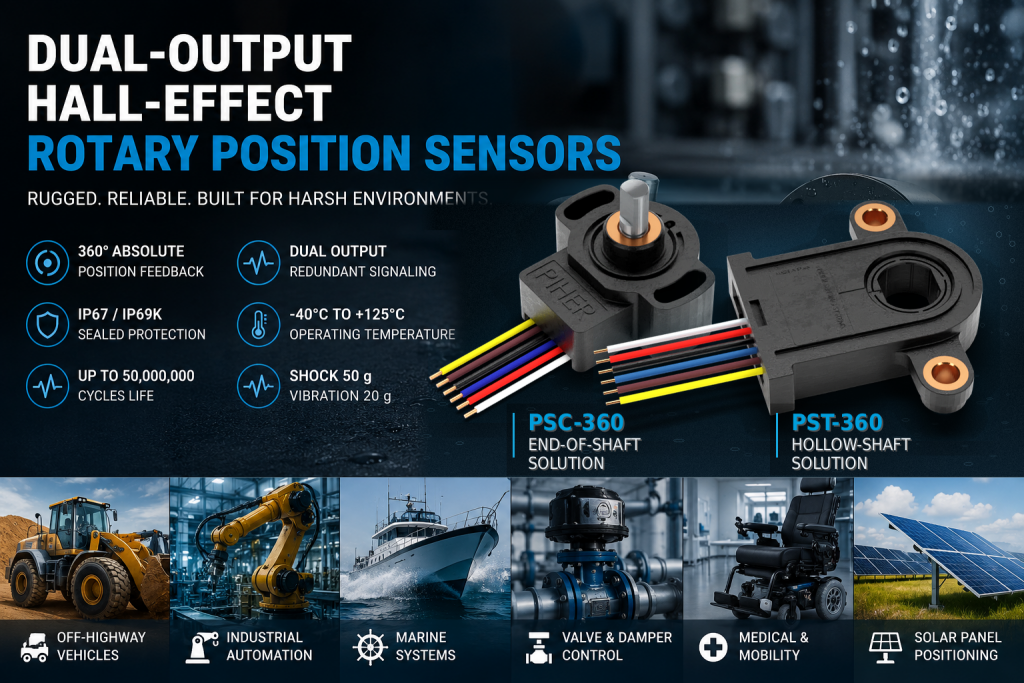 Some application visuals on this page use AI-generated backgrounds. PIHER product images are real.
Rotary position feedback is easy to underestimate until the sensor is installed on a machine that vibrates, gets washed down, operates outdoors, or runs through millions of duty cycles. Linkages loosen. Potentiometric tracks wear. Shafts move slightly out of alignment. Moisture, dust, temperature swings, and mechanical stress can turn a simple angle measurement into a reliability problem.
Non-contact Hall-effect rotary position sensors solve many of these problems by measuring angular position without relying on a contacting resistive element. A magnet and sensing IC are used to produce a position signal proportional to shaft rotation. Since the sensing element does not need physical contact with a wiper or track, the design can reduce wear and support long service life in demanding applications.
For engineers designing position feedback into industrial equipment, off-highway vehicles, robotics, marine systems, material handling equipment, valves, pedals, steering systems, and HVAC dampers, the main question is not only which sensing technology to use. The larger question is how the sensor should fit the mechanical design, how much redundancy the control system needs, and which output signal best suits the electronics.
Piher Sensors addresses these decisions with two complementary 360-degree Hall-effect rotary sensor platforms: PSC-360, an end-of-shaft rotary position sensor, and PST-360, a through-shaft or hollow-shaft rotary position sensor.
Why non-contact Hall-effect sensing fits rugged rotary applications
Traditional contact-based rotary sensing can be effective in controlled conditions, but harsh applications often introduce vibration, contamination, humidity, mechanical play, and high operating cycles. In these environments, non-contact Hall-effect sensing offers a practical design advantage because the measurement is based on the magnetic field relationship between the rotating element and the sensing electronics.
This matters in B2B equipment design because rotary feedback is rarely an isolated function. It is tied to uptime, control accuracy, operator safety, preventive maintenance, warranty exposure, and system diagnostics. A steering angle sensor, valve position sensor, pedal position sensor, robot joint sensor, or damper feedback sensor must keep reporting consistent data while the machine continues to work in real conditions.
The PSC-360 and PST-360 are built around this non-contact approach. Piher describes the PSC-360 as a robust, cost-effective non-contact rotary position sensor for harsh environments, with a permanent magnet securely fastened to the shaft as the only moving component in the sensor. Redundant dual-output versions provide independent voltage outputs with customizable characteristics, and full redundancy with separate supplies and grounds is possible.
PSC-360: end-of-shaft feedback for compact rotary measurement
The PSC-360 is designed for applications where the sensor can be mounted at the end of a shaft. This configuration works well when the mechanical layout allows direct access to the shaft end and the design team wants a compact, sealed rotary sensor with flexible electrical options.
The PSC-360 supports 360-degree absolute position feedback with endless mechanical rotation and programmable electrical angles from 15° to 360°. Piher lists analog ratiometric, PWM, CAN SAE J1939, and CANopen output options for the PSC-360, with simple, redundant, and full-redundant configurations available. The product page also identifies optional switch output capability, programmable transfer functions, and support for low- and high-voltage power supplies.
This makes PSC-360 suitable for applications such as:
| Application | Rotary feedback need |
|---|---|
| Pedal position | Proportional signal for operator input |
| Steering angle | Angle feedback for control and monitoring |
| Forklift mast tilt | Position feedback in material handling |
| Valve monitoring | Flow and process control feedback |
| Conveyor systems | Rotary movement or actuator position |
| Marine steering and shifters | Rugged feedback in wet environments |
| HVAC dampers | Airflow control and position confirmation |
The PSC-360 is especially useful when the system needs a rugged end-of-shaft sensor with a configurable signal rather than a one-size output curve. Piher specifies up to 12-bit resolution for PSC-360 output options, voltage protection of ±10 V, IP67/IP69K sealing, shock resistance of 50 g, vibration resistance from 5 Hz to 2,000 Hz at 20 g, and rotational life up to 50,000,000 cycles.
PST-360: hollow-shaft sensing at the pivot point
Some machines do not leave enough space for an end-of-shaft sensor. Others benefit from measuring directly around the rotating shaft or pivot. For those designs, Piher’s PST-360 offers a through-shaft, often described as hollow-shaft, rotary sensing format.
The PST-360 allows the application shaft to pass through the sensor. This is important when the sensor should be mounted directly at the pivot point, or when designers want to avoid extra levers, connecting rods, brackets, and mechanical interfaces. Piher states that the PST-360 does not rely on gears or other rotating parts, and that mounting at the pivot point eliminates the need for levers or connecting rods. The product page also notes that the design adapts to shaft eccentricity, mounting tolerances, and mechanical wear over the life of the application.
This mechanical approach can simplify designs such as:
| Application | Why a hollow-shaft sensor helps |
|---|---|
| Steering column modules | Sensor can sit around the shaft axis |
| Robot joints | Direct joint angle feedback |
| Boom angle and bucket position | Fewer linkage-related tolerance issues |
| Lift platforms | Compact pivot-point position feedback |
| Hydraulic cylinder pivots | Angle feedback where linkage space is limited |
| Marine outboard steering | Feedback around a rotating shaft or pivot |
| Medical mobility equipment | Compact rotary feedback in space-constrained mechanisms |
| Solar panel positioning | Direct angular feedback for outdoor motion control |
The PST-360 provides programmable electrical angles from 15° to 360° and supports analog ratiometric, PWM, SPI, CAN SAE J1939, and CANopen outputs, depending on configuration. Piher lists simple, redundant, and full-redundant versions, with programmable switch output on request and self-diagnostic features. The PST-360 datasheet lists up to 12-bit resolution for analog, PWM, and CAN versions, and up to 14-bit resolution for SPI versions.
Dual output for redundancy and fault detection
Many rugged applications need more than one position signal. In transportation, off-highway equipment, steering, pedals, robotics, and controlled actuators, a second output can help the control system compare signals and detect faults. A dual-output rotary position sensor can support safer feedback architecture by providing two independent signals from the same mechanical measurement point.
PSC-360 redundant dual-output versions provide independent voltage outputs with customizable characteristics. Piher also states that full redundancy with two separate supplies and grounds is possible. PST-360 also includes dual-output capability for redundant signaling, with output options that include redundant and full-redundant configurations.
This is valuable when the control system needs to check whether the sensor signal remains plausible. One output can be configured as a standard rising signal while the second can be configured as an inverted or independent signal, depending on the model and required output function. The controller can then compare the expected relationship between the two outputs and flag an error if the signal pair falls outside the defined logic.
Signal options for industrial and mobile control systems
A rotary position sensor has to match the electrical architecture around it. Some systems need a simple analog signal into an ADC. Others need PWM, SPI, CANopen, or CAN SAE J1939 communication. Fleet, mobile equipment, and industrial control platforms often have established communication standards, while compact embedded controllers may prefer analog or PWM.
The PSC-360 supports analog ratiometric, PWM, CAN SAE J1939, and CANopen outputs. The PST-360 adds SPI availability in addition to analog, PWM, CAN SAE J1939, and CANopen. Both platforms offer programmable electrical angles from 15° to 360°, and both support configuration flexibility for different applications.
This flexibility helps engineering teams avoid redesigning the mechanical system around a fixed sensor curve. Instead, the sensor output can be selected and configured around the actual electrical angle, supply voltage, control input, and diagnostic requirement.
Built for harsh environments
Rotary sensors in industrial and vehicle applications are often exposed to more than rotation. They may see pressure washing, dust, moisture, vibration, shaft misalignment, shock, and temperature extremes. A reliable position sensor must maintain signal quality while the rest of the machine experiences real field conditions.
Piher lists IP67/IP69K sealing for the PSC-360 and PST-360. The PSC-360 specifications include operating and storage temperature of -40°C to +125°C for analog and PWM versions, with CAN versions listed from -40°C to +85°C. The PST-360 lists the same temperature pattern for analog, PWM, SPI, and CAN configurations. Both platforms list shock resistance of 50 g and vibration resistance from 5 Hz to 2,000 Hz at 20 g.
Both product families are also specified for rotational life up to 50,000,000 cycles. That life rating, combined with non-contact sensing, makes them practical candidates for high-duty-cycle applications where maintenance access is difficult or machine downtime is expensive.
Choosing between Through-shaft and End-of-shaft
Both sensors provide non-contact Hall-effect rotary position feedback. The best choice depends on the mechanical interface.
| Design requirement | Better fit |
|---|---|
| Sensor can mount at the end of the shaft | PSC-360 |
| Shaft must pass through the sensor | PST-360 |
| Pivot-point measurement is preferred | PST-360 |
| Compact end-of-shaft installation is available | PSC-360 |
| Application needs dual-output redundancy | PSC-360 or PST-360, depending on mechanical layout |
| Application needs SPI output | PST-360, or PSC-360U depending on configuration |
| Application needs CAN SAE J1939 or CANopen | PSC-360 or PST-360, depending on configuration |
| Application has linkage tolerance concerns | PST-360 can reduce linkage dependency |
| Application needs configurable electrical angle | PSC-360 or PST-360 |
In simple terms: choose PSC-360 when the shaft-end mounting format fits the machine. Choose PST-360 when the shaft should pass through the sensor, when space is limited, or when direct pivot-point sensing can reduce mechanical interfaces.
Application examples
Industrial automation and robotics: Robot arms, automated warehouse vehicles, conveyors, and process equipment often require repeatable angular feedback. PSC-360 and PST-360 can provide non-contact position data for motion control, actuator monitoring, and joint position feedback.
Material handling and off-highway equipment for OEMS: Fork height, mast tilt, boom angle, bucket position, hitch position, and steering angle all depend on rugged feedback in high-vibration environments. Dual-output configurations can help support diagnostic strategies in these systems.
Valve and damper control: Flow control and air-management systems need position feedback to confirm actuator movement and maintain stable control. A Hall-effect rotary sensor can help monitor valve angle, damper position, and actuator status without relying on a contact track.
Marine systems: Steering, shifter, throttle, trim, and rudder feedback need sensors that can operate in wet, corrosive, and vibration-heavy conditions. Non-contact rotary sensing helps reduce the wear mechanisms associated with contacting sensors.
Medical and mobility equipment: Compact motion systems, such as mobility chair steering and electric bed positioning, need consistent angle feedback in limited spaces. PST-360’s through-shaft format can be useful where the sensor must fit around an existing shaft or pivot.
Design-in considerations
Before selecting a rotary position sensor, define the mechanical and electrical requirements together. Key questions include:
| Design question | Why it matters |
|---|---|
| Is the shaft end accessible? | Determines end-of-shaft versus hollow-shaft format |
| What is the required electrical angle? | Defines the programmed sensing range |
| Does the controller need analog, PWM, SPI, or CAN? | Determines output configuration |
| Is redundancy required? | Drives single, dual, or full-redundant selection |
| What supply voltage is available? | Affects part selection and output behavior |
| What environmental rating is needed? | Confirms sealing, temperature, shock, and vibration suitability |
| Are nearby materials ferromagnetic? | May affect linearity and should be reviewed during design-in |
| Is a custom connector required? | Impacts integration and production assembly |
Harsh environment rotary position sensing is not only a sensor choice. It is a mechanical, electrical, and reliability decision. Non-contact Hall-effect technology helps reduce wear, while dual-output configurations support redundancy and fault detection in demanding systems.
Piher’s PSC-360 and PST-360 give engineers two practical paths to rugged rotary feedback. PSC-360 fits end-of-shaft applications where compact integration and configurable outputs are needed. PST-360 fits through-shaft or hollow-shaft applications where direct pivot-point sensing can reduce linkages and tolerate real-world mechanical variation.
For equipment designers working in industrial automation, transportation, off-highway machinery, robotics, marine systems, medical devices, HVAC, and material handling, these two sensor platforms provide a flexible foundation for reliable 360-degree rotary position feedback in harsh environments.