

PSE Contactless Rotary Position Sensor: Precise Feedback for Harsh Control Environments
The PSE panel-mount rotary position sensor is an customiseable digital potentiometer solution for demanding control environments where precision, durability, and reliable feedback are top priorities. Thanks to Hall-effect sensing and contactless operation, it provides accurate position measurement with limited wear throughout its operating life. Its resistance to humidity, vibration, shock, dust, and extreme temperatures makes the PSE particularly suitable for industrial controls, transportation equipment, medical devices, armrest controls, foot switches, pedal position sensing, and test and measurement systems.
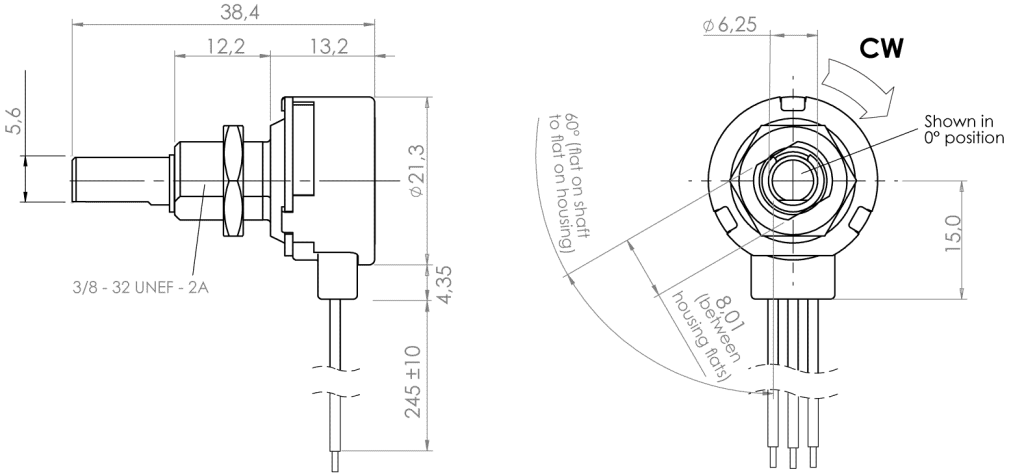
Unlike conventional contact-based position sensors, the PSE operates without gears or mechanical sensing interfaces. The magnet is securely integrated into the shaft and acts as the sensor’s only moving component, simplifying assembly and calibration while reducing the potential for mechanical deterioration. As a result, the sensor provides consistent position feedback under intensive operating conditions and helps extend maintenance intervals in applications exposed to repeated movement, vibration, and shock. See the PSE sensor datasheet here.
The rugged package protects the internal sensing components against dust, moisture, vibration, and extreme temperatures. This environmental resistance supports reliable operation in harsh industrial and transportation environments where conventional mechanical sensing technologies may be affected by contamination or intensive use.
With a resolution of 12 bits and absolute linearity of ±1%, the PSE is particularly suitable for applications where precise positioning or the detection of subtle rotary movements is critical. An improved absolute linearity of ±0.5% is available upon request. Because the PSE is an absolute sensor, it retains the measured position after a power failure, allowing the control system to recover the position value without re-homing the sensor.
The PSE is available with electrical angular ranges of 50°, 90°, 120°, 180°, 270°, and 360°. A continuous-rotation version combines endless mechanical rotation with electrical angles programmable from 15° to 360° without a deadband. For applications requiring defined mechanical travel, a second version limits rotation to 290°. These alternatives allow engineers to adapt the sensor to different control-panel, HMI, pedal, armrest, and machine-control concepts.
Compact & Robust Construction – Flexible Integration
The PSE combines durable contactless sensing with adaptable electrical and mechanical options. Standard output protocols include analog ratiometric and PWM, while programmable transfer functions, switch outputs, different redundancy levels, customer-specific output curves, and custom shaft configurations are available to address specific application requirements.
Its compact panel-mount and end-of-shaft configuration supports integration into operator controls and equipment with limited installation space. The integrated shaft also removes the need for a separate magnetic actuator assembly, helping simplify mechanical integration and calibration.
For engineers seeking a small but robust position-feedback solution for industrial knob controls, transportation systems, medical equipment, and operator interfaces, the PSE offers a durable and adaptable alternative to traditional contact-based position sensors. Its combination of contactless operation, environmental resistance, absolute position detection, and high-resolution measurement can help reduce wear-related maintenance and support dependable machine operation.
In short, the PSE is the link between robust machine construction and high-precision rotary control. Its Hall-effect technology, integrated shaft, configurable sensing range, and resistance to harsh operating conditions make it a strong choice for demanding HMI and position-feedback applications.
| Comparison | Magnetic non-contact potentiometer | Panel mount contacting potentiometer |
|---|---|---|
| Visual | 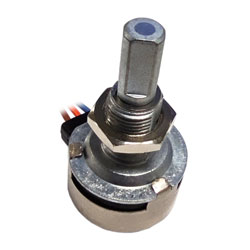 | 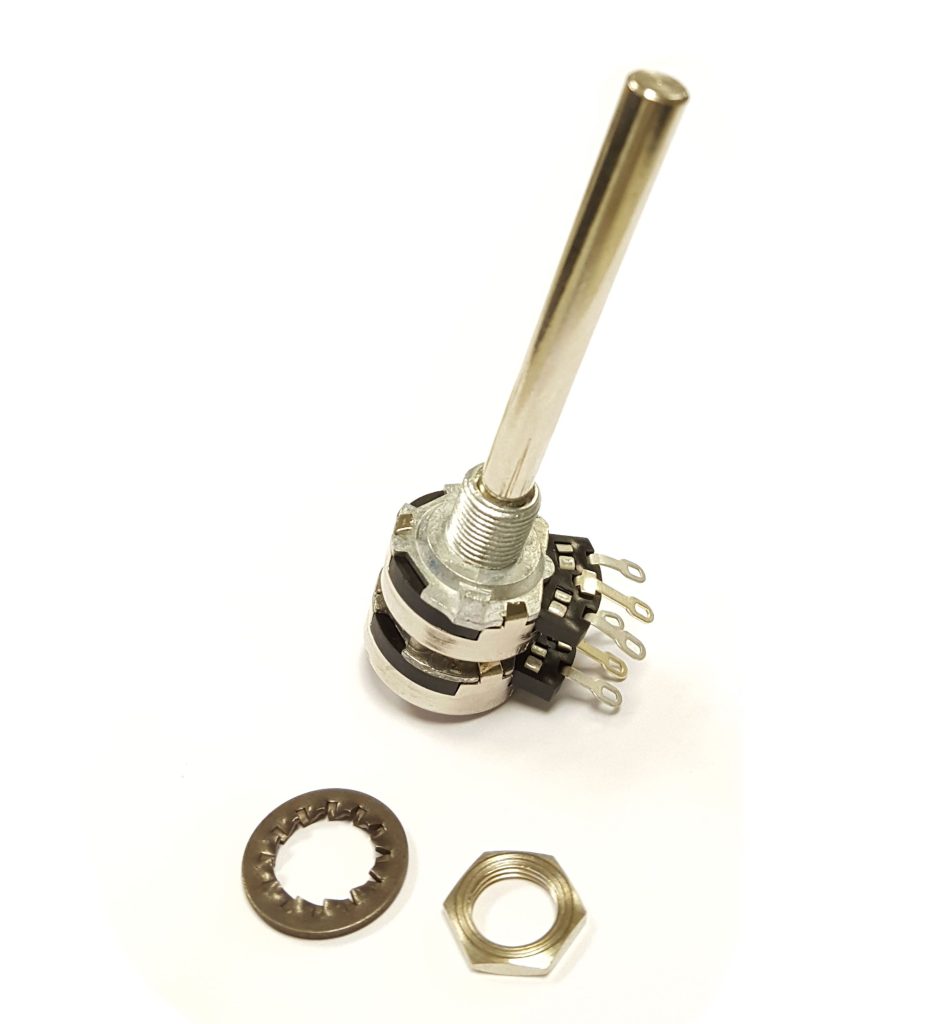 |
| Sensing technology | Contactless magnetic position detection based on the Hall effect | Mechanical wiper moving across a carbon resistive element |
| Contact within sensing system | No physical contact between the magnetic sensing elements | Direct contact between the wiper and resistive track |
| Wear | Limited sensing wear because there are no contacting measurement interfaces | Wiper and resistive track are subject to mechanical wear |
| Operating life | Better suited to high-cycle applications and extended operation | Suitable for conventional adjustment applications, but operating life is limited by contact wear |
| Environmental resistance | Designed to withstand dust, moisture, vibration, shock, and temperature variations | Better suited to protected panel-control environments |
| Signal stability | No resistive track to wear or accumulate contact contamination | Signal stability can be affected over time by track wear, contamination, or changes at the contact point |
| Electrical noise | No wiper-related contact noise | Mechanical contact can produce electrical noise during adjustment |
| Output type | Active analog ratiometric or PWM position output | Passive variable-resistance output |
| Power requirements | Requires a compatible power supply | Can operate as a passive component within the connected circuit |
| Resolution | 12-bit output resolution | Continuous analog resistance change without a defined digital resolution |
| Linearity | Typical ±1% to ±0.1% | Depends on the selected resistance, taper, and configuration. Piher can customise it. |
| Position after power loss | Absolute position is available when power is restored | The wiper remains mechanically positioned, providing the corresponding resistance when the circuit is powered |
| Rotational options | Continuous 360° rotation or mechanically limited | Continuous 360° rotation or mechanically limited |
| Electrical angle | Programmable electrical angles | Fixed electrical travel according to the selected configuration |
| Customization | Transfer functions, output curves, shafts, switch outputs, protocols, and redundancy levels | Resistance values, tapers, terminals, shafts, detents, mechanical stops, and integrated switches |
| Diagnostics | Integrated self-diagnostic capabilities | No integrated electronic diagnostics |
| Integration | Requires power and a compatible electronic interface | Simple integration into voltage-divider and resistance-control circuits |
| Relative cost | Generally higher initial cost due to technology and integrated electronics | Generally more economical for conventional manual controls |
| Maintenance requirements | Low maintenance because the sensing system is contactless | May require replacement after extended use due to mechanical wear |
| Typical applications | Industrial controls, transportation equipment, pedals, armrest controls, medical devices, and test equipment | Audio controls, multimedia controls, speed adjustment, welding equipment, and general manual panel controls |
Selection Guide
Choose the Non-contacting sensor when:
- High operating life is important.
- The application involves frequent rotational cycles.
- The equipment is exposed to dust, moisture, vibration, or shock.
- Preciseposition feedback is required.
- Digital output is needed.
- Continuous rotation or a programmable electrical angle is required.
- Diagnostics, redundancy, or customized output functions are important.
- Reducing maintenance and downtime is a priority.
Choose the Panel Mount Potentiometer when:
- A simple and economical manual adjustment is required.
- A passive variable-resistance output is preferred.
- Linear, logarithmic, or reverse-logarithmic tapers are needed.
- Detents or an integrated mechanical switch are required.
- The application operates in a relatively protected environment.
- The expected number of adjustment cycles does not justify contactless technology.
The contactless position sensor prioritizes operating life, environmental resistance, precision, and electronic functionality. The contacting potentiometer prioritizes simplicity, cost efficiency, tactile options, and direct resistive control.
The appropriate choice depends on the operating environment, number of rotational cycles, required signal type, maintenance expectations, customization needs, and target cost.