When Magnet Alignment Becomes a Mechanical Problem: A Better Approach to Pedal Position Sensing

Magnetic position sensing is often selected because it provides contactless measurement, low wear and reliable operation. However, the sensing technology alone does not determine the performance of the complete system.

The mechanical integration of the magnet, shaft and rotary sensor can be equally important.

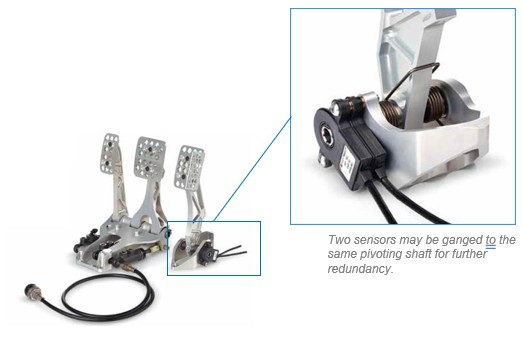
Consider a pedal position application in which a separate magnetic sensor reads the movement of the pedal through a plastic linkage. Although the sensing element operates correctly, the magnet must remain precisely centred relative to the sensor.

Maintaining this alignment can be difficult when the pedal is exposed to:

  • Repeated mechanical loads
  • Vibration
  • Linkage deflection
  • Component tolerances
  • Bearing play
  • Material deformation
  • Mechanical wear
Through-Shaft Rotary Position Sensor

These factors can cause the magnet to shift relative to the sensing element, resulting in an unstable or wandering output signal.

The issue is not necessarily the magnetic sensing technology. It is the mechanical arrangement required to position the external magnet.

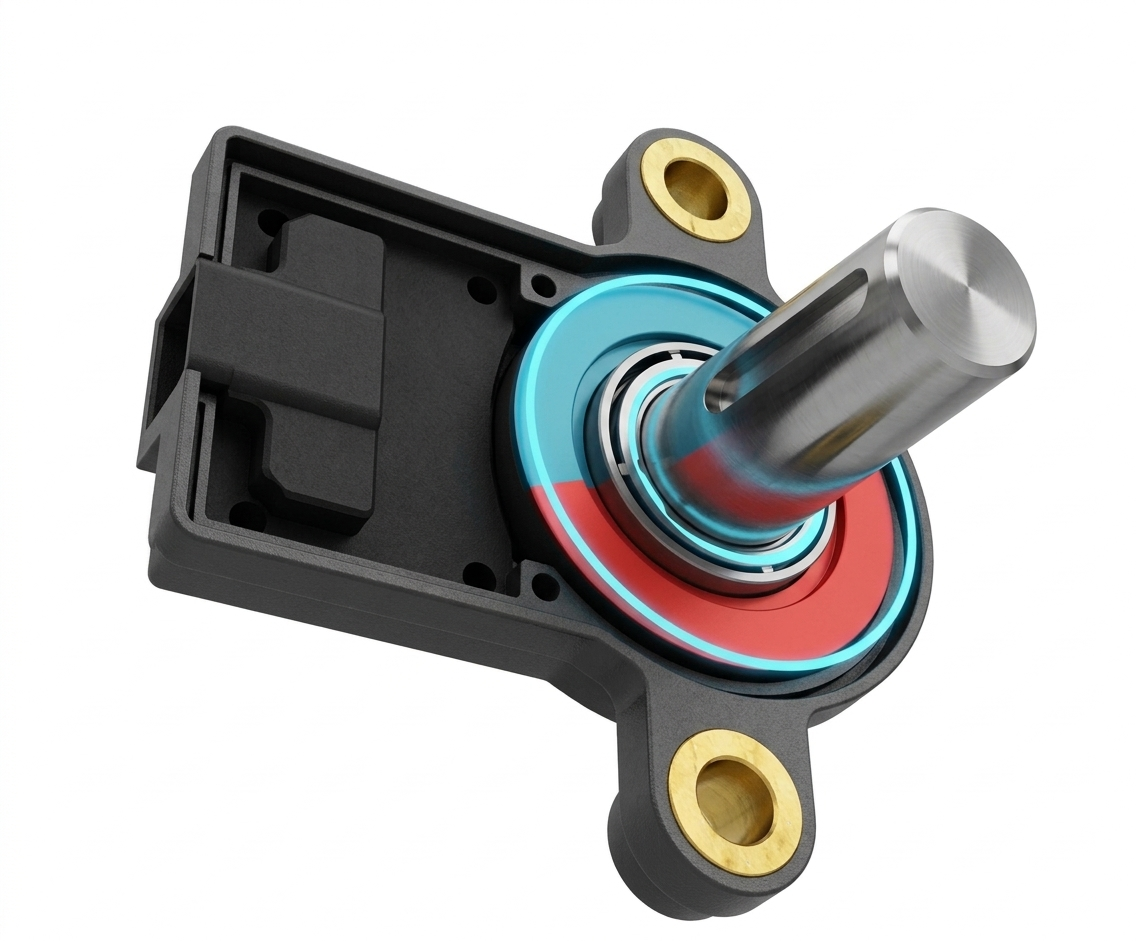
A contactless through-shaft sensor such as the Piher PST-360 offers a different approach. Its magnetic system is integrated into the sensor, and the application shaft passes directly through the rotor. This allows the sensor to measure angular movement directly at the pivot point without external magnets, levers, gears or connecting rods.

This type of challenge illustrates an important principle:

A contactless sensor is only as reliable as the mechanical interface connecting it to the application.

The remainder of the article can stay unchanged, except for the section titled“Solving the Mechanical Cause, Not Only the Electronic Symptom,” which should be replaced with the following:

Solving the Mechanical Cause, Not Only the Electronic Symptom

When an absolute magnetic sensor produces an unstable signal, the first reaction may be to add software filtering or modify the control electronics. However, these measures do not correct movement or misalignment between an external magnet and the sensing element.

Software filtering may reduce visible signal variation, but it can also affect response time. Strengthening the magnet holder or linkage may improve alignment, but it adds components and mechanical complexity.

A more effective approach is to reconsider the sensing architecture.

The PST-360 measures rotation directly at the pivot point and integrates the magnet into the sensor assembly. This reduces dependence on the dimensional stability and alignment of external components.

Its principal value proposition includes:

  • Direct angle measurement at the pivot point
  • Integrated ring magnet and Hall sensing element
  • Tolerance of shaft eccentricity and mounting variation
  • No external magnet holder
  • No gears, levers or connecting rods
  • Programmable electrical ranges from 15° to 360°
  • Absolute position feedback
  • Up to 50 million rotational cycles
  • IP67 and IP69K sealing of the electronics
  • Simple, redundant and fully redundant dual-channel configurations
  • Analog, PWM, SPI and CAN output options

For pedals, steering systems, joysticks, valves, robotic joints and mobile machinery, selecting the right sensor involves more than choosing a magnetic sensing IC. The complete mechanical interface must remain stable throughout the application’s operating life.

By integrating the magnetic system into a robust through-shaft package, the PST-360 helps replace a tolerance-sensitive external magnet arrangement with a simpler and more controlled position-sensing solution.


ConsiderationExternal magnet arrangementPST-360 through-shaft sensor
Magnet installationDesigned and controlled by the application manufacturerRing magnet integrated into the sensor (plug & play)
AlignmentDepends on maintaining the required magnet position relative to the sensing elementMagnetic alignment is managed within the sensor assembly
Mechanical connectionMay require a holder, linkage, coupling or additional supportMounts directly at the rotating pivot
Assembly variationInfluenced by the external magnet and mounting stack-upReduced external magnetic assembly requirements
Wear-related movementLinkage or holder wear may affect magnet positionTrue non-contact sensing with no gears or internal mechanical transmission
Angular rangeDepends on the selected IC and system designProgrammable from 15° to 360°
Environmental protectionDepends on the complete customer assemblyElectronics sealed to IP67 and IP69K
RedundancyRequires additional system designSimple, redundant and fully redundant options available
Output configurationDetermined by the selected sensing ICAnalog, PWM, SPI and CAN options available

pedal angle sensorPiher contactless technology for Pedal Angle Sensor is NOT sensitive to the intensity of the magnetic field applied to the ICs. They are only sensitive to the direction of the field.

This is a huge practical ADVANTAGE as it means that the distance between the magnet and the IC can vary during the life of the sensor without changing the integrity of the sensor’s output. Mechanical play in the moving parts of the sensor can never be confused with a braking action.

> No precision shaft, bearings, etc are required
> No precision magnetic circuit is required.
> No stator and no yoke.
> Not sensitive to magnet ageing or temperature.
> No mechanical linkage is required between the pedal and sensor. 

Solving the Mechanical Cause, Not Only the Electronic Symptom

An unstable sensor signal is not always caused by the sensing electronics. In many applications, the underlying issue is the mechanical arrangement used to position the magnet relative to the sensing element.

The challenge is not simply to select another Hall-effect device. It is to choose a sensing architecture that reduces sensitivity to shaft movement, mounting tolerances, linkage deflection and mechanical wear.

This is where the PST-360 provides its main value:

  • Direct measurement at the pivot point
  • Integrated magnet and sensing element
  • Tolerance of shaft eccentricity and mounting variation
  • No external gears or linkages
  • Programmable electrical range
  • Absolute position feedback
  • Long operating life
  • Sealed construction for demanding environments
  • Multiple output and redundancy configurations

For pedals, steering systems, joysticks, valves, robotic joints and mobile machinery, selecting the right sensor involves more than choosing a magnetic sensing IC. The complete mechanical interface must remain stable throughout the product’s operating life.

By integrating the magnetic system into a robust through-shaft package, the PST-360 helps engineers replace a tolerance-sensitive external magnet arrangement with a simpler, more controlled position-sensing solution.
Technical Inquiry

Every application has different angular, mechanical, electrical and diagnostic requirements. Piher can support the selection of the rotor, electrical angle, transfer function, output type, supply voltage and redundancy architecture for the target system.

Contact us to discuss your through-shaft position-sensing application or to evaluate a PST-360 configuration for pedal, steering or pivot-point measurement.

Contact Technical SupportAsk our AI Assistant
Piher