

Position, Speed and Tilt Sensors: The Feedback Layer Behind Intelligent Robotics
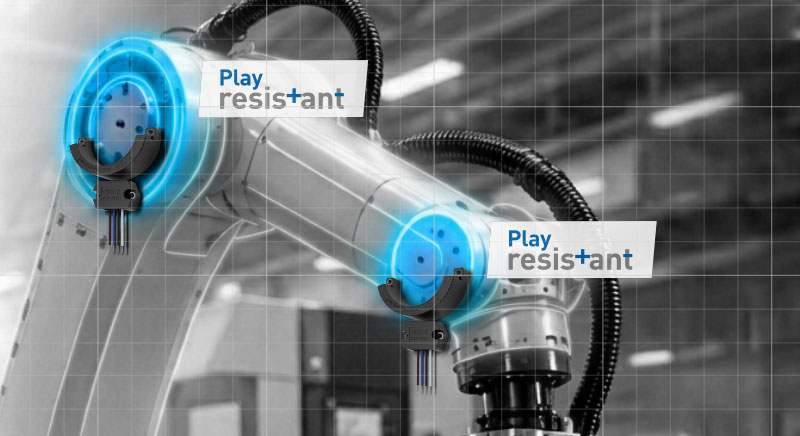
Robotics is moving from programmed movement toward systems that can perceive their environment, make decisions and respond in real time. Artificial intelligence and edge computing are enabling robots to process increasingly complex information locally, but intelligent decision-making still depends on accurate information about the machine itself.
A robot needs to know where its mechanisms are, how they are moving and whether its structure is correctly oriented. This physical feedback connects the digital control system with the mechanical world.
Position, speed and tilt sensors provide this feedback.
From industrial robotic arms and autonomous mobile robots to collaborative machines and emerging humanoid platforms, these sensing technologies support closed-loop control, motion coordination and system stability. As robotic systems become more autonomous, reliable sensing becomes increasingly important to the way they interact with the physical world.
From AI decisions to physical movement
An intelligent robot operates through a continuous cycle.
It senses. It processes information. It makes a decision. It acts. It measures the result and adjusts its next action.
AI can help interpret vision data, identify objects, plan routes or adapt to changing conditions. However, the control system also needs precise information about the robot’s physical state.
- Where is the joint?
- How far has the actuator moved?
- How fast is the mechanism rotating?
- Is the platform level?
- Has the robot moved away from its expected position?
These are physical variables that must be measured continuously.
Position, speed and tilt sensors provide the feedback required to close this loop between computation and movement.
Position sensing: knowing where the mechanism is
Position feedback is fundamental to robotic motion control. It allows a controller to determine the angular or linear position of a mechanism and compare the actual position with the commanded position.
In a robotic arm, position sensors can monitor individual joints. In a gripper, they can determine whether the mechanism is open, closed or somewhere between the two. In mobile robotics, position feedback can be used for steering, actuators, lifting mechanisms and other moving assemblies.
Typical applications include:
- Robotic arm joints
- End effectors and grippers
- Linear actuators
- Steering mechanisms
- Lift systems
- Mobile robotics
- Material handling equipment
- Automated machinery
For high-cycle robotic applications, contactless sensing can provide an important advantage. Hall-effect and inductive technologies measure movement without requiring mechanical contact between the sensing element and the moving target.
Reducing mechanical contact can help minimize wear and support long operating life in systems that perform continuous movement.
Rotary position feedback for robotic motion
Angular position sensing is particularly important where motors, shafts, joints and steering mechanisms must be controlled continuously.
Piher’s contactless rotary position sensors can provide absolute angular feedback for applications where long service life, environmental resistance and integration flexibility are important.
Depending on the sensor architecture, available interfaces can include analog, PWM, CANopen and SAE J1939, allowing position feedback to be integrated into different control architectures.
For robotic systems, this type of sensing can support:
- Joint position feedback
- Steering angle measurement
- Actuator monitoring
- Conveyor and material handling systems
- Mobile robot drive systems
- Autonomous warehouse equipment
Speed sensing: controlling how the robot moves
Knowing position is only part of the control problem. A robot also needs to know how quickly a mechanism is moving.
Speed feedback allows the controller to manage acceleration, deceleration and synchronization between moving elements. It can also help identify unexpected changes in machine behaviour.
Speed can be measured directly using dedicated sensing technologies or derived from changes in position over time. In either case, the objective is the same: provide the control system with timely information about motion.
Speed feedback can support:
- Motor and actuator control
- Robotic joint movement
- Conveyor systems
- Autonomous mobile robots
- Automated guided vehicles
- Pick-and-place equipment
- Dispensing systems
- Motion synchronization
For autonomous machines, the timing of this feedback matters. The longer the delay between physical movement and the control system receiving that information, the harder it becomes to maintain precise control.
This makes response time, signal quality and sensor integration important considerations when selecting a motion-sensing solution.
Tilt sensing: understanding orientation
Robots do not always operate on perfectly level surfaces.
Mobile robots can travel across ramps, uneven floors or changing terrain. Agricultural and construction machines may operate on slopes. Lifting equipment can experience changes in platform angle. Legged and humanoid robots need to continuously manage balance and body orientation.
Tilt sensors, or inclinometers, measure angular inclination relative to gravity and provide direct information about the orientation of the system.
Tilt feedback can be used for:
- Autonomous mobile robots
- Agricultural robotics
- Construction and inspection equipment
- Warehouse vehicles
- Lifting platforms
- Service robots
- Humanoid and legged robots
- Machinery operating on slopes
Vision systems can help a robot understand its surroundings, but they do not replace direct measurement of the machine’s orientation. An inclinometer provides a dedicated measurement of inclination that can be incorporated into the robot’s control and safety logic.
Bringing sensing closer to the control loop
Modern robotics increasingly combines AI processing, embedded control and machine-level I/O in a single system architecture.
This convergence changes the role of sensors.
Sensors are no longer simply components that provide data to a controller. Their signals form part of the real-time feedback loop that connects perception, computation and physical action.
A typical robotic control loop can be represented as:
Sensor → Controller → Actuator → Mechanical movement → Sensor feedback
AI and edge computing can operate alongside this loop, processing additional information from cameras and other sensors to support higher-level decisions.
The control system then combines these inputs with direct measurements of position, speed and orientation.
This combination allows the robot to distinguish between what it expects to happen and what is actually happening.
Contactless sensing for demanding robotic environments
Robotic systems can operate continuously for thousands or millions of cycles. They may also be exposed to vibration, temperature changes, dust, humidity and electrical interference.
Sensor technology therefore has to be considered alongside the mechanical and electrical environment.
Contactless sensing technologies such as Hall-effect and inductive sensing eliminate physical contact between the sensing element and the moving target. This can reduce mechanical wear and support long operating life in high-cycle applications.
Inductive sensing can also be useful in applications where the presence of magnetic fields or ferromagnetic components needs to be considered as part of the sensor design.
The appropriate technology depends on the mechanical arrangement, target material, sensing range, accuracy, environmental conditions and required interface.
More autonomous robots require more reliable feedback
The evolution from fixed industrial robots to autonomous machines is increasing the amount of information that robots need to process.
A conventional robotic arm operating in a controlled environment may primarily require precise joint feedback.
An autonomous mobile robot may additionally require steering position, wheel or motor speed, actuator position and tilt information.
A more complex robotic platform can combine these measurements with vision, force, proximity and other sensing technologies.
As the number of sensing points increases, sensor architecture becomes an important part of the overall system design.
Engineers need to consider not only sensor accuracy, but also:
- Response time
- Repeatability
- Mechanical integration
- Environmental resistance
- Electrical interfaces
- Diagnostic requirements
- Redundancy
- Operating temperature
- Expected lifetime
- Maintenance requirements
The sensor must ultimately work as part of the complete control system rather than as an isolated component.
Designing the feedback layer for robotics
The performance of an autonomous machine depends on the quality of the information available to its control system.
Position sensors provide information about where a mechanism is.
Speed sensing provides information about how it is moving.
Tilt sensors provide information about how the machine is oriented.
Together, they form a fundamental feedback layer between the robot’s mechanical system and its digital control architecture.
As AI enables robots to make increasingly sophisticated decisions, this physical feedback remains essential. A robot can use AI to decide what it should do, but it still needs reliable sensor data to determine what is happening and to control the resulting movement.
Piher sensing solutions for robotics
Piher develops position, speed and tilt sensing solutions for applications where continuous feedback, mechanical integration and long-term reliability are important.
Our technologies can support:
- Contactless rotary position sensing
- Linear position measurement
- Speed and direction detection
- Tilt and inclination measurement
- Motor and actuator feedback
- Steering and joint position sensing
- Mobile and autonomous robotics
- Industrial automation and material handling
By combining the appropriate sensing technology with the mechanical and electronic requirements of the application, engineers can build the feedback layer required for accurate, responsive and reliable robotic control.
The next generation of robotics depends on feedback
AI is changing what robots can perceive and how they make decisions. Edge computing is reducing the time between sensing, processing and action.
The physical machine still needs something else: reliable feedback.
Position, speed and tilt sensors provide direct information about the state and movement of the robot. They help controllers compare commanded behaviour with actual machine behaviour and make corrections in real time.
For robotic systems, intelligence and physical control are therefore closely connected.
The future of robotics is not only about making machines capable of understanding more. It is also about giving them the sensing capability required to act with greater precision, responsiveness and control.
