

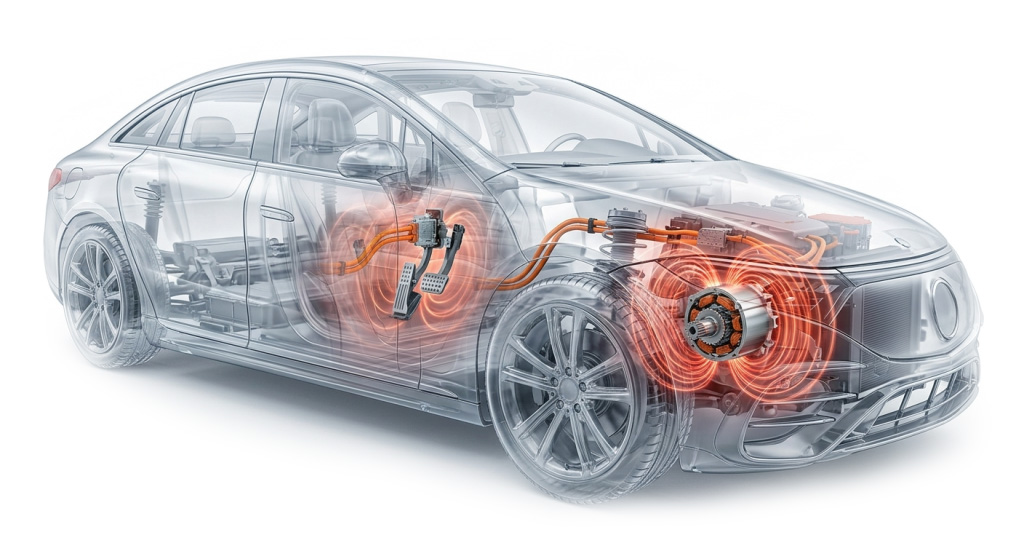
The design of modern electric vehicles and automated factories has created a difficult environment for traditional sensors. As we pack high-voltage cables and powerful motors into tighter spaces, the resulting electromagnetic interference becomes a significant hurdle. In safety-critical systems like electronic braking or steer-by-wire, even a minor measurement error caused by a nearby magnetic field can lead to system failure.
The Problem with External Fixes
For a long time, the industry relied on physical shielding to protect sensors from these “stray” fields. While a metal shield can work, it is often a clumsy solution. It adds weight and volume to a component that needs to be as small as possible. Furthermore, shields can saturate if the external field is too strong, and their performance often shifts as temperatures change. For engineers, this adds another layer of complexity to an already difficult assembly process.
Why Integrated Immunity is Different
At Piher, we take a different approach. Instead of trying to block the interference with a physical barrier, we design the sensor architecture to ignore the noise entirely. This is achieved through two primary methods that focus on the physics of the magnetic field itself.
1. Vertical Sensitivity and Differential Sensing
One of the most effective ways to handle interference is to limit what the sensor actually “sees.” Many of our sensors are designed to be sensitive primarily to magnetic fields in the Z-direction (vertical to the chip surface). By ignoring horizontal influences, we eliminate a large portion of ambient noise.
To handle vertical interference, we use a differential sensing layout. The chip contains multiple sensing elements that measure the magnetic field at different points. Because a stray field is typically uniform across the small area of the sensor, it hits every element with the same strength. Our internal logic subtracts this common noise, leaving only the precise signal from the target magnet.
 2. High-Frequency Inductive Technology
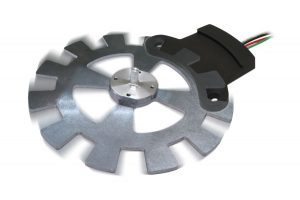
In environments where magnetic noise is extreme, such as directly inside an electric motor, we often move away from magnets entirely. Our inductive sensors use high-frequency electromagnetic coupling. Because these sensors operate at frequencies much higher than the interference generated by vehicle drivetrains, the noise simply does not register. It is a natural, physical immunity that does not require extra parts or specialized materials.
The Practical Value for Your Project
Moving the immunity inside the sensor provides several immediate benefits for the production line and the end user: