
Manufacturer of Angle, Position, Speed, Tilt and Current Sensors

Non-contact rotary position sensor using Hall effect technology to deliver accurate, reliable angular measurement in demanding environments. Designed for long service life and high safety applications, they feature dual independent outputs and robust environmental protection.
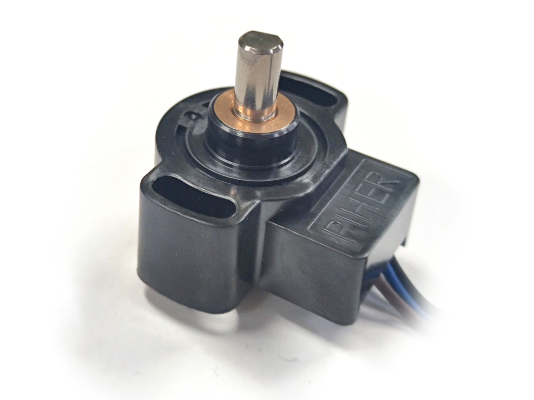
replacement for rotary position sensors Key Features

  • Full angular measurement: 0–360°
  • Non-contact Hall effect technology (no wear)
  • Dual redundant outputs (analog, PWM and other options) two-channel 
  • High resistance to shock and vibration
  • Sealing up to IP67 / IP69K
  • Stable performance across wide temperature ranges

Typical Applications

  • Electronic pedals (accelerator / brake) with two outputs 
  • Fork position / inclination 
  • AGVs wheel
  • Mast height and angle
  • Valve position control
  • Steering systems
  • Agricultural and construction machinery
  • Avionics / Defence
  • Heavy-duty industrial equipment
  • Lift machines and elevators 
  • Aerial platforms
  • Articulated and telescopic boom lifts – Accurate rotation feedback for boom positioning
  • Scissor lifts – Platform height and tilt monitoring
  • Material handling equipment – Feedback for hydraulic valves and actuators

Autonomy demands fault-tolerant position tracking to ensure operational boundaries are respected. Piher redundant and dual-output position sensors satisfy safety for autonomous off-highway vehicles standards (ISO 25119 for agriculture, ISO 13849 for construction) to prevent subsystem communication errors.

Why Choose a Non-Contact Position Sensor?

Unlike variable resistor sensors, magnetic position sensors eliminate mechanical wear, ensuring longer lifespan, improved signal stability, and reduced maintenance.
They are especially suitable for safety-critical systems where reliability is essential. 

Configurable Options

  • Electrical angles: 60°, 90°, 120°, 180°, 360°
  • Output types: analog, PWM, SPI, CAN
  • Connector types, wiring 
  • Various shaft actuators, levers and mounting configurations

Need a Compatible Replacement for a position sensor?

If you’re replacing an existing 360° rotary position sensor, this solution offers functional compatibility with many commonly used OEM industrial sensors.

Our team can help you identify the best match based on your electrical, mechanical, and environmental requirements.
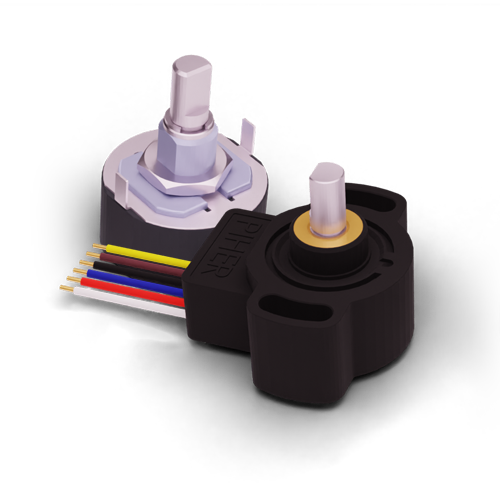

End of shaft dual position sensing

Technical Overview

  • Technology: Hall effect
  • Measurement range: up to 360°
  • Output: simple or dual channel (redundant)
  • Supply voltage:  5V, 7-15V
  • Protection rating: IP67 / IP69K
  • Operating temperature: industrial grade

Piher Sensing Systems engineers precise, contactless rotary position sensors for automotive and industrial motor control. Utilizing inductive and Hall-effect technologies, these adaptable sensors resist stray magnetic interference and deliver accurate angular data. The compact designs ensure reliable operation and strict functional safety compliance across extreme temperatures.

Self-Diagnostics: Unmanned or semi-autonomous heavy machinery require continuous monitoring of their functional envelopes to flag wear or drift before catastrophic failure occurs. High-accuracy position sensors enable the control system to detect mechanical deviations early.

Frequently Asked Questions

What is a dual output sensor?

A dual output sensor provides two independent signals for redundancy, improving system safety and fault detection.

What are the advantages of Hall effect sensors?

They offer non-contact operation, no mechanical wear, longer lifespan, and higher reliability.

Can this sensor replace other rotary position sensors?

Yes, as long as key parameters such as angle range, output type, and mechanical interface are matched.

What protection rating do I need?

For harsh environments, IP67 or IP69K is recommended.

Can this sensor replace other 360° rotary position sensors?

Yes, it can be used as a functional replacement when key specifications such as angle range, output type, and mechanical fit are matched.

What should I check before replacing a rotary position sensor?

Verify electrical output, mechanical dimensions, mounting type, and environmental protection.

What should I check before replacing a rotary position sensor?

Verify electrical output, mechanical dimensions, mounting type, and environmental protection.

Is this sensor suitable for safety-critical applications?

Yes, versions with dual redundant outputs are designed for applications requiring increased safety and reliability.

Can you show me some dual-output examples?

Can you show me the wiring scheme for a redundant dual output rotary sensor?

Can you show me the wiring scheme for a full-redundant dual output rotary sensor?

Primary Industries
  • Robotics / Industrial

    Provides precise angular feedback for joints and actuators.

  • Agriculture / HVOR

    Monitors equipment positioning in harsh, outdoor environments.

  • Marine

    Ensures corrosion-resistant tracking for rudder and throttle controls.

  • Medical

    Enables accurate movement in surgical instruments and diagnostic imaging beds.

  • Defense

    Supports ruggedized feedback systems in unmanned vehicles and weapon stations.

  • Material Handling

    Manages fork tilt and lift heights in warehouse logistics.

Vehicle & Motion Applications
  • Pedals and Throttles

    Translates driver or operator input into electronic signals without the wear of physical contact.

  • Steering

    Tracks wheel angle and steering column position for power-assist systems.

  • Chassis Height

    Measures suspension travel to maintain vehicle leveling and stability control.


If you’re searching for a widely used 360° rugged rotary position sensor with dual output and non-contact technology, this solution offers equivalent functionality and performance.

Rotary position sensor replacement and alternatives

Drop-in Rotary Position Sensors for Integrated Control

Direct-Fit rotary position sensors serve as direct replacements for traditional mechanical potentiometers or older sensors. Because they integrate into existing hardware, they eliminate the need for extensive mechanical redesigns or system modifications. This compatibility streamlines the upgrade process and reduces operational downtime. These components typically employ non-contact technology to improve reliability across a variety of demanding sectors and specific mechanical functions:

This sensor is designed to match the key requirements typically expected in industrial and off-highway applications. It is a reliable option for engineers and buyers needing a functionally compatible alternative when sourcing or replacing existing rotary position sensors.

This rotary position sensor is commonly selected as a replacement solution for:

  • Industrial rotary position sensors with dual analog outputs
  • Non-contact angular sensors used in heavy-duty equipment
  • Sealed Hall-effect sensors for automotive and machinery applications
  • Stray-field immune position sensors

Why choose a dual-output non-contact sensor for off-highway vehicles?

Modern off-highway vehicles incorporate semi-autonomous functions that shift operators from manual control to system supervision. This architectural change requires human-machine interfaces to process real-time physical telemetry without latency. The dual-output design provides the redundant signal pathways necessary to satisfy functional safety standards, including ISO 25119 for agricultural machinery and ISO 13849 for construction equipment. By delivering independent position tracking streams, the sensor ensures that control systems can verify operational boundaries and initiate safe fallback states if a subsystem anomaly occurs.

Applications in Supervisory HMI and Drive-by-Wire Systems

As mechanical linkages are replaced by electronic control architectures, position feedback devices act as the primary translator between physical operator commands and digital controllers.

  • Drive-by-Wire Joysticks and Pedals: Non-contact Hall-effect technology eliminates mechanical wear, ensuring high reliability in dusty, wet, and high-vibration environments.

  • Boom and Attachment Geometry Tracking: Edge-computing display architectures require accurate, low-latency position values to calculate dynamic payloads and surface actionable metrics to operators.

  • Functional Envelope Monitoring: Continuous absolute position measurement allows controllers to track mechanical limits and prevent over-extension during automated cycles.

Technical Comparison: Non-Contact Sensor vs. Traditional Potentiometers

Feature Piher 360 Non-Contact Sensor Traditional Contact Potentiometer
Wear Mechanism Contactless magnetic Hall-effect Physical wiper-to-resistive track friction
Operational Lifespan Millions of cycles without degradation Prone to track wear and signal noise over time
Environmental Resistance Sealed against dust, moisture, and vibration Susceptible to contamination and electrical noise
Redundancy Dual independent electrical outputs Typically single output unless custom packaged

Technical Comparison: Absolute Position Sensor vs. Rotary Encoder

Feature Piher 360 Non-Contact Position Sensor Rotary Encoder (Incremental / Absolute)
Position Tracking Outputs absolute angular position immediately upon power-up. Incremental encoders output relative pulse counts requiring a homing routine; absolute encoders track multi-turn position via digital protocols.
Mechanical Scope Designed for angular measurement across an axis, ideal for linkages, pedals, and joysticks. Engineered for continuous multi-turn shaft rotation and high-speed motor feedback.
System Integration Direct shaft or magnet mounting with redundant analog or digital outputs for functional safety. Often integrated into motor housings or complex servo drives requiring specialized communication interfaces.
Primary Use Case Heavy-duty off-highway angle and position feedback (boom geometry, throttle, steering). Motor speed regulation, velocity control, and closed-loop servo positioning.

Technical Inquiry

Discuss specific integration requirements or mechanical customization options with our engineering team.

Contact Technical SupportAsk our AI Assistant